How Many Drinks Is Over the Legal Limit in Florida?
In Florida, a law enforcement officer can make an arrest for Driving Under the Influence (DUI) based on the officer’s observations of indicators of impairment.
Table of Contents
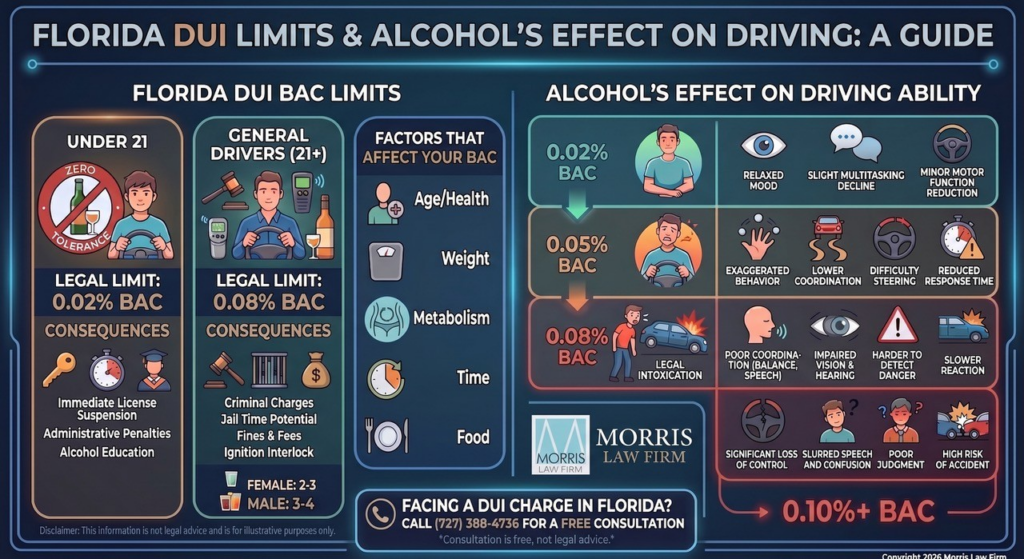
There is no set number of drinks that puts everyone over Florida’s legal alcohol limit. For most adult drivers, a blood alcohol concentration (BAC) of 0.08 or higher is one basis for a DUI charge, but you can also face a DUI charge below that level if your normal faculties are impaired. Your alcohol intake, drinking pace, body composition, and other factors affect your BAC, so counting drinks cannot tell you whether you can legally drive.
If you have been arrested in St. Petersburg or Pinellas County, the number of drinks you consumed is only part of the picture. The traffic stop, officer observations, and testing procedures can all affect your case. Contact Morris Law Firm to discuss your circumstances.
Under Florida Statute § 316.193, a person may commit DUI if they are driving or in actual physical control of a vehicle and either:
Their normal faculties are impaired by alcohol, certain chemical substances, or controlled substances;
Their blood-alcohol level is 0.08 or higher; or
Their breath-alcohol level is 0.08 or higher.
Florida therefore does not require prosecutors to prove a BAC of 0.08 or higher in every DUI case. Evidence of impairment can provide a separate basis for a charge.
Florida’s Under-21 Zero-Tolerance Law
Florida has a separate zero-tolerance law for drivers under age 21.
Under Florida Statute § 322.2616, a driver under 21 who has a blood- or breath-alcohol level of 0.02 or higher can face an administrative driver’s-license suspension. A first violation generally carries a six-month suspension under the statute.
It is important not to describe 0.02 as simply the “DUI limit” for everyone under 21. The under-21 provision creates a separate administrative rule. A criminal DUI charge is governed by Florida’s DUI statute and may depend on impairment, a BAC of 0.08 or higher, or other applicable evidence.
Florida Statute § 322.62 states that a person with any alcohol in their body may not drive or be in actual physical control of a commercial motor vehicle. A violation can result in being placed out of service for 24 hours. A blood- or breath-alcohol level of 0.04 or higher can trigger additional commercial-driver consequences.
The 0.04 figure therefore should not be described as the only alcohol restriction that applies to Florida commercial drivers. Florida's commercial-motor-vehicle statute is stricter.
The ordinary DUI statute may also apply independently when its requirements are met.
How Many Drinks Does It Take to Reach a 0.08 BAC?
There is no accurate formula that can tell a particular person, “You can have two drinks and still legally drive.”
Factors That Affect Blood Alcohol Concentration
BAC can vary based on numerous factors, including:
How much alcohol a person consumes
How quickly they drink
Body size and body composition
Whether and when they have eaten
The alcohol content and serving size of each drink
Individual metabolism
Why Counting Drinks Can Be Misleading
Even drinks that look similar may contain substantially different amounts of alcohol. A cocktail may contain more than one standard serving of alcohol, and beer can vary significantly in alcohol content.
For that reason, charts estimating BAC based on body weight and number of drinks should not be treated as a reliable way to decide whether it is safe or legal to drive.
Coffee, Food, and Other “Sobering Up” Myths
Common attempts to “sober up” should not be relied upon to make driving safe.
Food may affect how alcohol is absorbed when consumed before or while drinking, but eating afterward does not instantly remove alcohol already in the body. Coffee may make someone feel more alert without eliminating the alcohol responsible for impairment.
Cold showers, exercise, and similar strategies likewise should not be treated as ways to make a person legally safe to drive.
If there is any question about impairment, the safer choice is not to drive.
DUI Charges Below 0.08 BAC in Florida
A common misunderstanding is that a driver cannot be convicted of DUI unless a breath or blood test shows 0.08 or higher. Florida law separately prohibits driving or being in actual physical control of a vehicle when a person’s normal faculties are impaired.
Florida Statute § 316.1934 also addresses how alcohol-test results may be considered as evidence. A result of 0.05 or lower creates a presumption, for purposes covered by the statute, that the person's normal faculties were not impaired by alcohol. A result above 0.05 but below 0.08 does not create a presumption either way and may be considered together with other competent evidence. A result of 0.08 or higher is prima facie evidence of impairment.
That means the surrounding evidence can matter in a case involving a BAC below 0.08.
Impairment of Normal Faculties
Florida law uses the phrase “normal faculties” when defining impairment. These faculties include abilities such as seeing, hearing, walking, talking, judging distances, driving, making judgments, responding to emergencies, and carrying out ordinary mental and physical activities.
During a DUI investigation, officers may document observations they believe suggest impairment. Those observations can become evidence, but an arrest does not establish guilt.
A person accused of DUI is presumed innocent unless and until the state proves the charge beyond a reasonable doubt.
Alcohol Testing in a Florida DUI Investigation
A DUI investigation may involve several different types of evidence. Officers may make observations about a person's driving, speech, balance, appearance, behavior, or other circumstances.
An officer may also request field sobriety exercises during an investigation. Chemical testing is a separate issue.
Florida’s implied-consent statute provides for approved breath testing after a lawful arrest under specified circumstances when an officer has reasonable cause to believe the person was driving or in actual physical control while under the influence of alcohol. Florida law also contains provisions governing blood and urine testing in particular circumstances.
The legality, administration, maintenance, and evidentiary use of a particular test can become important issues in a DUI defense.
License Suspension and Criminal Penalties for Test Refusal
Under Florida's administrative suspension statute, a first qualifying refusal can result in a one-year driver's-license suspension, while a subsequent qualifying refusal can result in an 18-month suspension. The statute also provides procedures for challenging an administrative suspension.
Under Florida Statute § 316.1939, a first refusal of a lawful breath or urine test can also be a second-degree misdemeanor when the statutory requirements are met. A second or subsequent qualifying refusal can be a first-degree misdemeanor. Blood-test refusals involve separate legal requirements and should not be treated as interchangeable with breath or urine refusals.
A refusal does not automatically prove that someone was driving under the influence. It may, however, create additional legal and driver's-license issues.
Because refusal cases can involve both criminal and administrative proceedings, anyone facing this situation should obtain individualized legal advice promptly.
Steps to Take After a Florida DUI Arrest
After a DUI arrest, avoid trying to determine the strength of the case simply from the number of drinks you consumed. DUI cases can involve many different forms of evidence, and a breath-test number is only one possible part of the case.
You have the right to remain silent and the right to consult a criminal defense attorney. A Florida DUI defense lawyer can review issues such as:
A charge is an accusation, not a conviction, and the prosecution has the burden of proving its case.
Frequently Asked Questions About Florida’s DUI Limit
Is 0.08 the Legal Limit in Florida?
For most adult motorists, a blood- or breath-alcohol level of 0.08 or higher is one statutory basis for DUI. Florida also permits a DUI charge based on impairment of normal faculties, so a person can potentially face DUI allegations without a test result of 0.08 or higher.
Can You Drive After One Drink in Florida?
There is no rule guaranteeing that one drink; or any specific number of drinks; is safe for every driver. Alcohol affects people differently, and Florida DUI law is not based solely on counting drinks.
Can You Be Arrested for DUI if You Blow Under 0.08?
Potentially, yes. Florida law allows DUI charges based on impairment of normal faculties in addition to the 0.08 BAC or breath-alcohol standard.
Is 0.05 Over the Legal Limit in Florida?
A BAC of 0.05 is below Florida’s 0.08 threshold for most adult drivers. A result of 0.05 or less creates a statutory presumption against alcohol impairment, but other competent evidence may still be considered. Separate restrictions apply to drivers under 21 and people operating commercial vehicles.
What Is the Limit if You Are Under 21 in Florida?
Florida's zero-tolerance law provides for administrative consequences when a driver under 21 has a blood- or breath-alcohol level of 0.02 or higher. That rule should be distinguished from the separate criminal DUI statute.
Can I Challenge a Breath Test Result?
Depending on the circumstances, a defense attorney may examine whether a test was lawfully requested, whether required procedures were followed, and whether the evidence is reliable and admissible. The availability and strength of a challenge depend on the facts of the individual case.
Speak With a St. Petersburg DUI Defense Lawyer
Knowing Florida's 0.08 threshold is useful, but a DUI case cannot be reduced to a chart showing how many drinks a person had. The state may rely on chemical-test results, officer observations, video, statements, and other evidence.
If you have been arrested for DUI in St. Petersburg or Pinellas County, Morris Law Firm can discuss your circumstances and the options available to you.
The information on this website is for general information purposes only. Nothing on this site should be taken as advice for any individual case or situation. This information is not intended to create, and receipt or viewing does not constitute client relationship.