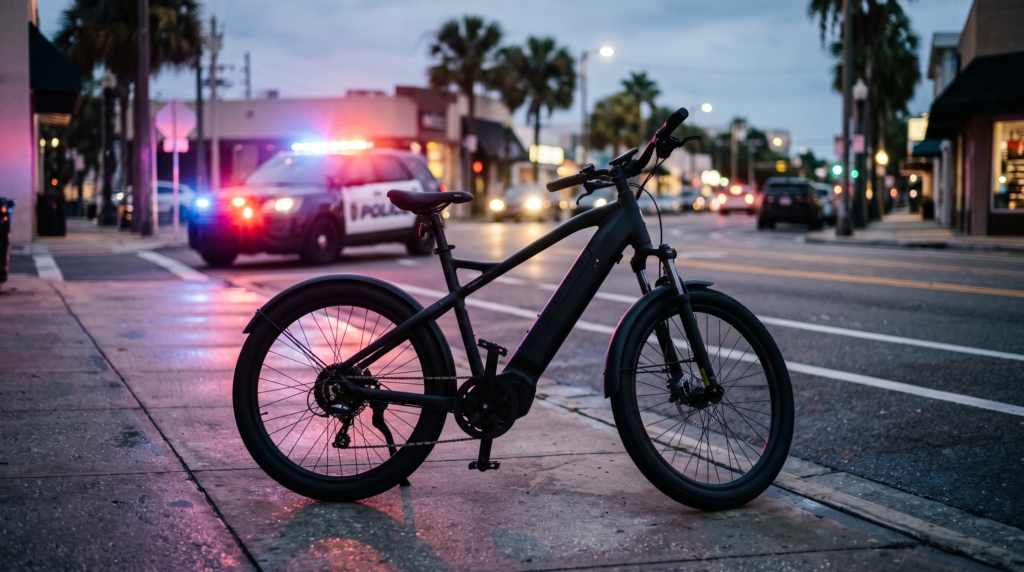
As electric bicycles (e-bikes) explode in popularity across the Tampa Bay Area, law enforcement is aggressively cracking down on riders who push the limits of the law. From downtown St. Petersburg and the neighborhoods of Shore Acres, Snell Isle, and Venetian Isles to the Pinellas Trail, police are actively targeting e-bike riders—including juveniles—for serious traffic and criminal offenses.
If you or your child has been cited or arrested while riding an e-bike, you might assume it is just a simple traffic ticket. It is not. What begins as a joyride can quickly escalate into permanent criminal records, steep fines, and even felony charges.
If you or your teen are facing e-bike criminal charges in Pinellas County, call (727) 388-4736 to talk with our defense team at the Morris Law Firm.
1. The Local Crackdown Leading to E-Bike Criminal Charges
Recent safety concerns have prompted a wave of targeted enforcement across our community. High-profile incidents of collisions, injuries, and reckless riding including wheelies and blocking traffic have made headlines across the Tampa Bay Times, Bay News 9, and WFLA. In recent operations, the St. Petersburg Police Department stopped dozens of personal electric vehicle riders, issuing citations and impounding vehicles on the spot.
Lawmakers and police are fielding daily complaints about teenagers and adults weaving through traffic, speeding down pedestrian sidewalks, and causing accidents. As a result, authorities are no longer issuing warnings. They are formally filing criminal charges, and parents are increasingly finding themselves in the crosshairs of criminal responsibility for their children's actions.
2. Why Modified E-Bikes Are Legally Reclassified as Motorcycles
The confusion for many parents and riders stems from how Florida law defines an electric bicycle. Under Florida Statute § 316.003(23), a legal e-bike must have a motor of 750 watts or less, functional pedals, and a maximum motor-assisted speed of 28 mph. When an e-bike meets these exact criteria, it is treated like a traditional bicycle: no driver’s license, registration, or insurance is required.
However, the advent of high-powered electric bikes—such as Sur-Rons, Talarias, and other modified electric dirt bikes—has drastically changed the landscape. Because these vehicles frequently lack pedals, exceed 750 watts, and can reach speeds of 40 to 60+ mph, law enforcement actively treats them as motorcycles or mopeds.
Once an e-bike crosses that statutory threshold, the rider instantly becomes subject to the exact same strict motor vehicle laws as someone operating a gas-powered motorcycle or passenger car on public roads.
3. The Most Common E-Bike Criminal Charges in Pinellas County
We have recently seen a significant spike in Tampa Bay Area e-bike riders—both adults and juveniles—facing serious charges in county and traffic court:
- Fleeing and Attempting to Elude Law Enforcement (F.S. § 316.1935): A third-degree felony (or higher). Young riders frequently panic when police activate emergency lights or sirens and attempt to speed away through alleys, parks, or sidewalks. Fleeing law enforcement carries severe statutory penalties, potential incarceration, and mandatory driver's license revocations.
- Reckless Driving (F.S. § 316.192): A criminal misdemeanor for operating any vehicle with a willful or wanton disregard for the safety of persons or property. Popping wheelies, weaving between pedestrians on crowded downtown St. Petersburg sidewalks or darting across multi-lane traffic commonly triggers this charge.
- Operate an Unregistered Motor Vehicle (F.S. § 320.02): A second-degree misdemeanor punishable by up to 60 days in jail and a $500 fine. When police reclassify an electric bike as a motor vehicle, operating it on a public road without a state registration and license plate is charged as a crime.
- No / Improper Driver's License – 1st Offense (F.S. § 322.03): A second-degree misdemeanor. This is an extraordinarily common charge for juveniles who are under the legal driving age or lack a valid driver's license with the required motorcycle endorsement.
- Operating a Vehicle Without Insurance / Proof of Financial Responsibility (F.S. § 316.646): When an e-bike is deemed a motor vehicle, officers cite riders for failing to maintain and display proof of mandatory personal injury protection (PIP) and property damage liability insurance.
- Motorcycle/Moped Wheels Off Ground (F.S. § 316.2085(2)): Florida law explicitly mandates that any person riding a motorcycle or moped must maintain "both wheels firmly on the ground at all times." Popping wheelies on public streets or sidewalks leads to immediate citations under this statute, carrying substantial fines and potential license suspensions.
4. The Legal Catch-22: Challenging the "Unregistered Motor Vehicle" Charge
One of the most novel and aggressive defenses we utilize at the Morris Law Firm attacks the legal sufficiency of the "Operate an Unregistered Motor Vehicle" (F.S. § 320.02) charge for e-bikes.
Here is the fatal flaw in the State's prosecution: To register a motor vehicle with the Florida Department of Highway Safety and Motor Vehicles (FLHSMV), the vehicle must possess a standard, federally compliant 17-character Vehicle Identification Number (VIN).
Most e-bikes, electric dirt bikes, and e-motos do not have a compliant VIN because they are not manufactured as street-legal motor vehicles. Consequently, the FLHSMV will outright reject any attempt by an owner to register them.
The Legal Challenge: How can the State of Florida criminally prosecute a citizen for failing to register a vehicle that the State itself makes legally impossible to register? We challenge the legal basis of these e-bike criminal charges in court, arguing that applying this statute to a non-VIN electric bike creates a legal impossibility and violates fundamental constitutional due process rights.
5. How E-Bike Violations Trigger Parental Criminal and Civil Liability
Many parents purchase high-powered e-bikes or electric dirt bikes for their children believing they are simply harmless toys. However, Florida prosecutors are increasingly scrutinizing parents when unlicensed teenagers operate illegal, non-compliant e-motos on public roadways:
- Criminal Charge: Permit Unlicensed Minor to Drive (F.S. § 322.35): Under Florida law, it is a Second-Degree Misdemeanor to authorize or knowingly permit a minor child under the age of 18 to operate a motor vehicle upon any highway or public road when that minor is not legally licensed to do so. If you purchase an illegal, non-compliant e-bike that Florida classifies as a motor vehicle and allow your child to ride it on public streets, law enforcement can criminally cite or arrest you directly. A second-degree misdemeanor carries penalties of up to 60 days in jail, 6 months of probation, and a $500 fine.
- Civil Negligence and Financial Liability: In addition to potential criminal exposure, parents face severe civil liability under Florida’s parental responsibility and negligent entrustment doctrines. If an unlicensed teen causes an accident, strikes a pedestrian, or damages property while riding a high-powered electric bike, parents can be sued directly and held financially responsible for substantial medical costs and property damages.
6. Resolving Juvenile E-Bike Criminal Charges Through Diversionary Programs
Many of the individuals swept up in this recent crackdown are teenagers. A teenager riding a fast e-bike is usually just trying to have fun, completely unaware that their "toy" is classified by police as a motor vehicle. Yet, a juvenile conviction for charges like Fleeing and Eluding or Driving Without a License can derail college applications, jeopardize scholarships, harm future employment opportunities, and postpone their ability to obtain a Florida driver's license.
There is hope. Our firm frequently helps juveniles and their families navigate these terrifying situations. In many cases, we can successfully negotiate with the State Attorney's Office to place the youth into a juvenile diversionary program (such as Teen Court or Juvenile Pre-Arrest Diversion).
By completing community service, taking educational driving or safety courses, and fulfilling program conditions, the juvenile can earn a complete dismissal of the criminal charges (or a "Nolle Prosequi" or "No Information"), keeping their permanent record clean.
Talk to a Pinellas County Criminal Defense Attorney
If you or your child are facing e-bike criminal charges, you need a defense strategy that understands both the nuances of Florida traffic law and the shifting landscape of electric vehicle regulations. Do not let an e-bike ride turn into a permanent criminal record.
Melinda Morris is a former state prosecutor and served as a juvenile prosecutor for the Pinellas County State Attorney's office. She knows firsthand how the State evaluates juvenile dockets and traffic crimes. She uses that prosecutorial insight to dismantle the State's charges, challenge statutory overreach, and fight for full case dismissals.
Contact the Morris Law Firm today.
Call us at (727) 388-4736 or contact us online to schedule a confidential consultation.
Frequently Asked Questions About E-Bike Laws & Charges
What is the legal definition of an e-bike versus a motorcycle in Florida?
Under Florida Statute § 316.003(23), an electric bicycle is defined as a bicycle or tricycle equipped with fully operable pedals, a seat or saddle, and an electric motor of less than 750 watts (1 horsepower) that meets the requirements of one of three specific statutory classes.
A motorcycle, under F.S. § 316.003(47), is any motor vehicle having a seat or saddle for the rider, designed to travel on not more than three wheels, and powered by an engine or motor that does not fit the legal bicycle or moped exemptions. If an electric two-wheeler lacks functional pedals, has a motor exceeding 750 watts, or travels faster than 28 mph on motor power, Florida law no longer classifies it as an e-bike—it is treated as a motorcycle or moped.
What are the three classes of e-bikes under Florida law?
Florida recognizes three distinct classes of electric bicycles:
- Class 1: A bicycle equipped with a motor that provides assistance only when the rider is pedaling, and ceases to provide assistance once the bicycle reaches 20 mph.
- Class 2: A bicycle equipped with a throttle-actuated motor that can propel the bike without pedaling, but ceases to provide motor assistance once the bicycle reaches 20 mph.
- Class 3: A bicycle equipped with a motor that provides assistance only when the rider is pedaling, and ceases to assist when the bicycle reaches 28 mph. Class 3 e-bikes must also be factory-equipped with a working speedometer.
Why are popular e-bikes like Sur-Ron or Talaria getting riders arrested?
Many popular electric bikes—such as Sur-Ron Light Bee, Talaria Sting, and Segway Dirt eBikes—are engineered as lightweight off-road electric motorcycles. They typically feature motors well in excess of 750 watts (often 3,000 to 6,000+ watts), lack functional pedals, and can reach speeds of 45 to 60 mph or more. Because they exceed every statutory limit in F.S. § 316.003, police treat them as illegal unregistered motorcycles if ridden on streets, sidewalks, or public parks.
Do you need a driver's license, tag, or insurance for a legal e-bike in Florida?
No. Under Florida Statute § 316.20655, a compliant Class 1, Class 2, or Class 3 electric bicycle is expressly exempt from vehicle registration, license plate requirements, driver's license mandates, and mandatory motor vehicle insurance laws. You possess the same rights and duties as an ordinary pedal cyclist.
Can parents in Florida face e-bike criminal charges for their child's actions?
Yes. Under Florida Statute § 322.35, it is a second-degree misdemeanor to authorize or knowingly permit an unlicensed minor child to operate a motor vehicle upon a highway. If a parent buys an illegal, non-compliant e-moto and permits their unlicensed teen to ride it on public streets, prosecutors can file criminal charges directly against the parent. Furthermore, parents can face severe civil liability for financial damages caused by a minor's negligent operation under Florida's parental responsibility doctrines.
Can a juvenile e-bike criminal charge be expunged or dismissed in Pinellas County?
Yes. First-time juvenile offenders charged with traffic-related offenses or misdemeanors are often eligible for pre-arrest or post-arrest juvenile diversion programs. Successfully completing the assigned diversion conditions results in a formal dismissal of the charges. Once dismissed, the minor may be eligible to have their juvenile arrest record expunged under Florida law, ensuring it does not follow them into adulthood.