Florida DUI Statistics Around the Holidays

Holiday celebrations bring friends and families together across Florida, but they also bring a noticeable increase in impaired driving incidents. During this time of year, law enforcement agencies see spikes in arrests, alcohol related crashes, and roadside investigations. Knowing how DUI trends shift during the holidays can help drivers stay safe and avoid unexpected legal trouble.

Florida’s holiday months often come with heavier travel, more social events, and greater alcohol consumption. These factors combine to elevate the risk of DUI arrests throughout the state. The DUI attorneys at Morris Law Firm help individuals protect their rights when charges arise and provide the guidance needed to navigate the legal process. 

Holiday DUI Trends in Florida

Florida sees a consistent rise in DUI stops, arrests, and alcohol-related crashes during major holidays. Many of these incidents happen late at night or early in the morning as people travel home from parties or extended gatherings. The National Highway Traffic Safety Administration reported that over 1,038 people died in drunk driving accidents in December 2023 and expected that trend to continue. 

Because of this sharp rise, police are on the lookout for drunk driving behavior more than ever.

Law enforcement agencies typically report:

These trends highlight how common impaired driving becomes during the busiest travel periods of the year.

Most Common DUI or DWI Charges

During the holidays, the most frequent charges include:

These charges can carry severe consequences, especially in cases involving accidents or repeat offenses.

High-Risk Holidays for DUI Arrests

Some holidays consistently show higher DUI arrest numbers across Florida. These include:

These holidays often involve extended celebrations, vacation travel, and long weekends, creating conditions where alcohol related driving becomes more common.

Common Risk Factors During the Holidays

The holiday season introduces certain conditions that make impaired driving more likely. Some of the most common include:

These risk factors make it important for drivers to plan ahead and be mindful of their transportation options.

How Florida Law Enforcement Responds

To address the rise in DUI activity, law enforcement increases patrol efforts during major holidays. This may involve:

Drivers may also encounter more frequent breath testing, field sobriety evaluations, and requests for identification. Even minor traffic violations can lead to an officer investigating for impairment during these periods.

What to Do If You’re Arrested for DUI

A DUI arrest can be overwhelming, especially if it is your first DUI arrest. Taking the right steps afterward can protect your rights and improve your chances of a favorable outcome. If you are arrested, it is recommended to:

The decisions you make immediately after an arrest can have a major impact on your case. Whatever you do, do not fight the police if they are taking you into custody, stay off social media, and contact an attorney right away to handle your case.

Florida’s Drive Sober or Get Pulled Over Holiday Campaign

During the holidays, Florida participates in the national Drive Sober or Get Pulled Over campaign. This initiative aims to reduce impaired driving through increased visibility and public awareness. Campaign efforts include:

These campaigns contribute to the increased enforcement presence drivers often notice throughout the holiday season.

How Morris Law Firm Can Help After a Florida DUI Arrest

A DUI arrest can impact nearly every part of your life. You may face immediate license suspension, concerns about your job, increased insurance costs, and the possibility of criminal penalties. The legal process can move quickly, and the steps you take early on can significantly affect the outcome of your case. Having a knowledgeable criminal defense attorney on your side helps you avoid mistakes, understand your options, and build a strategic defense.

Morris Law Firm provides comprehensive support for individuals facing DUI charges during the holidays and throughout the year. Whether you’re a holiday traveller, a busy commercial driver, or just passing through, stay sober or get pulled over. From the moment you contact the firm, you receive guidance tailored to your situation and dedicated representation focused on protecting your rights and achieving the best possible result. Morris Law Firm can assist by:

If you were arrested for DUI during the holiday season or at any time of year, Morris Law Firm is ready to help. Contact us today at (727) 388-4736 for a free, confidential consultation and learn your options moving forward.

What Questions Do You Have to Answer During a DUI Stop in Florida?

Being stopped for a DUI can be overwhelming with flashing lights, intense questioning, and uncertainty about your rights. It’s essential to know that during a DUI stop, you are only required to answer specific questions, such as providing identification, but you have the right to remain silent on other matters to avoid self-incrimination. Staying calm, polite, and withholding answers beyond what is legally required can help protect your case later.

If you’re facing DUI charges, Morris Law Firm offers aggressive and knowledgeable legal defense to protect your rights and freedom. Our skilled criminal defense attorneys understand how to fight improper stops, inaccurate testing, and procedural mistakes that can make or break your case. 

Your Legal Obligations During a Florida DUI Traffic Stop

When an officer initiates a traffic stop in Florida, you are legally required to pull over safely and cooperate with basic identification requests. However, your obligation to answer questions is limited by your constitutional rights. The Fifth Amendment protects you from self-incrimination, meaning you do not have to provide information that could be used against you.

Things you must provide include:

These are standard documents that every driver must carry and show upon request. Refusing to provide them can lead to additional legal trouble, such as citations or charges for failing to comply with lawful orders.

Beyond providing identification and documentation, you are not legally required to answer further questions about where you were, what you were doing, or whether you consumed alcohol.

Questions You Are Not Required to Answer During a Florida DUI Investigation

After checking your license and registration, the officer may begin asking open-ended questions meant to gauge impairment or gather probable cause, such as:

While these questions may sound routine, law enforcement is not required to ask them. If you willingly answer these questions, your answers can be used as evidence in a DUI case. Even a small, seemingly harmless statement can later be interpreted as an admission.

If you are unsure what to say, it is perfectly lawful to remain polite yet firm. You might respond with something like, “I prefer not to answer any questions without an attorney present.”

This statement signals that you are aware of your rights while remaining cooperative.

Field Sobriety Tests and Breath Tests: Knowing Your Rights in a Florida DUI Stop

When stopped on suspicion of DUI, law enforcement may ask you to do two types of tests: field sobriety tests and a preliminary breath test (PBT). It is important to understand your rights regarding each.

Field Sobriety Tests: These are physical coordination tasks like walking a straight line, standing on one leg, or following an object with your eyes. In Florida, these tests are completely voluntary. You have the right to politely decline them without penalty. Many conditions such as tiredness, nerves, medical issues, or uneven terrain can cause poor performance, even if you haven’t been drinking.

Preliminary Breath Test (PBT): This is a portable breathalyzer used on the roadside before arrest. Like field sobriety tests, a PBT is voluntary, meaning you can refuse it without immediate penalties. However, if you are formally arrested for DUI, Florida’s implied consent law requires you to submit to a chemical test (breath, blood, or urine) at the station.

Refusing to take a post-arrest chemical test leads to immediate administrative penalties, including driver’s license suspension. Repeated refusals can cause harsher penalties and be used against you in court as evidence of guilt.

How to Conduct Yourself and Stay Calm During a DUI Stop

Even if you believe the stop was unfair, staying calm and respectful is the best approach. The officer’s observations—your tone, body language, and behavior—may appear later in their report and could be used as evidence.

A few key reminders during a DUI stop include:

If you are taken into custody, it’s important to immediately request an attorney and remain silent until your lawyer is present. Anything you say during or after the arrest can be used in court.

After the Stop: Protecting Your Future and Challenging Florida DUI Charges

If you are arrested or cited for DUI, what you do next matters. Florida imposes strict penalties for DUI convictions, including fines, license suspension, ignition interlock requirements, community service, and even jail time. Early legal intervention can help protect your rights and challenge any improper procedures or evidence.

A skilled DUI defense attorney can review whether the officer had probable cause, whether testing procedures were followed correctly, and whether your constitutional rights were respected during the stop.

Contact Our St. Petersburg DUI Defense Team for Legal Representation

At Morris Law Firm, we understand how stressful and confusing a DUI arrest can be. Our team has extensive experience defending clients in St. Petersburg and throughout Pinellas County, handling everything from first-time DUI charges to complex felony DUI cases.

Contact Morris Law Firm today at (727) 388-4736 to schedule a confidential consultation.

Do You Need to Contact the DMV After Your DUI in Florida?

After a DUI arrest in Florida, a driver faces two separate, simultaneous legal processes: a criminal case through the court system and an administrative action with the Department of Highway Safety and Motor Vehicles (DHSMV). Understanding how these interact, and what you need to do to protect your driving privileges, is vital.

With former prosecutor Melinda Morris’s inside knowledge of DUI law enforcement and prosecution tactics, Morris Law Firm offers strategic, skilled representation to protect both your license and your rights. Contact Morris Law Firm promptly after your DUI arrest for a free consultation and to ensure you don’t lose your driving privileges.

The Administrative License Suspension Process After a Florida DUI

When you are arrested for DUI in Florida, the arresting officer typically confiscates your driver’s license on the spot and issues a temporary driving permit valid for 10 days. This permit allows limited driving privileges usually for commuting to work, school, or necessary errands.

Once those 10 days begin, you must decide how to proceed. Under Florida law, you have two main options:

Failing to take any action within the 10-day window results in an automatic license suspension once the temporary permit expires.

Many drivers don’t realize that this administrative suspension occurs independently of the criminal DUI case. Even if your criminal case is later dismissed, the DHSMV can still enforce the suspension if you fail to act within the deadline.

Why Immediate Contact with the Florida DHSMV is Important

The Florida DHSMV’s Bureau of Administrative Reviews (BAR) handles license suspension challenges. Contacting the DMV or more specifically, the BAR, within the 10-day timeframe is critical to protecting your ability to drive.

By requesting a hearing, your attorney gains the opportunity to:

A skilled DUI defense attorney will often use the hearing as a chance to preview the state’s evidence before the criminal trial, identify weaknesses in the case, and potentially secure an outcome that protects both your record and your license.

Understanding Florida's Critical 10-Day DUI Rule and License Suspension Deadlines

Florida’s 10-day rule is one of the most important and most overlooked deadlines after a DUI arrest. During this time, your attorney can file a request for a DHSMV hearing to contest the administrative suspension or apply for a hardship license.

If you miss this window:

For most drivers, even a brief loss of driving privileges can cause serious challenges jeopardizing employment, education, and daily responsibilities. That’s why contacting a criminal defense attorney immediately after your arrest is essential.

Administrative vs. Criminal DUI Process in Florida: The Two Separate Cases

It’s easy to confuse the DMV process with the criminal case, but they serve very different purposes:

These two processes move independently. Even if you win your DMV hearing, you could still face criminal penalties. Conversely, if your criminal case is dismissed, your administrative suspension can still remain in effect unless it was properly challenged.

This separation often surprises people, but understanding it helps ensure that no deadlines or legal options are missed.

How a DUI Defense Attorney Protects Your License at the Florida DHSMV Hearing

Navigating both the DMV and criminal court processes can be overwhelming without experienced legal guidance. A knowledgeable DUI defense attorney can handle the necessary filings, represent you at hearings, and make sure your rights are fully protected throughout both cases.

Your lawyer can assess whether:

In many cases, an attorney can also negotiate for a hardship license, ensuring you can still commute to work or school while your case is pending.

Why Immediate Legal Intervention is Essential After a DUI Arrest

The period immediately following a DUI arrest is critical. Within just a few days, decisions must be made that can significantly affect your freedom, finances, and ability to drive. Waiting too long can mean losing important rights and options.

If you or someone you know has been arrested for DUI, the best step you can take is to contact a qualified attorney who understands how the Florida DMV and criminal justice systems work together and how to protect your interests in both.

Contact Our St. Petersburg DUI Defense Team Today

At Morris Law Firm, we represent clients in St. Petersburg and throughout Pinellas County who are facing DUI and other criminal charges. Our attorneys understand both the DMV process and the criminal courts and provide hands-on guidance through every step.

Contact Morris Law Firm today at (727) 388-4736 or visit us online to schedule a confidential consultation.

The First Steps to Take After a DUI in Florida

Being charged with a DUI in Florida is instantly stressful. From worrying about your driver’s license and insurance rates to navigating court dates and potential career impacts, it’s natural to feel uncertain about the path ahead.

The steps you take right now are the most critical for protecting your rights and regaining control of the situation. Your first move should be to focus on the legal defense. At Morris Law Firm, our DUI attorneys are here to explain the critical 10-day deadline for your license hearing, analyze the details of your stop, arrest, and field sobriety tests, and develop a strong legal strategy focused on minimizing penalties and protecting your future.

Reach out to our dedicated DUI attorneys today to get started.

What Happens When You Get a DUI in Florida

When you are pulled over on suspicion of DUI in Florida, the process can be fast and confusing. Understanding what happens is the first step toward regaining control of the situation:

What happens next depends on many factors, including your prior record and the specific circumstances of your arrest.

Understanding DUI Charges in Florida

Getting a DUI in Florida isn’t just about how much you had to drink; it’s about whether your ability to drive safely was affected. Florida law covers not only alcohol, but also drugs and even prescription medications that can impair your reaction times or alter your focus.

Here are some of the main factors that can shape what your DUI charge looks like in Florida:

Penalties for DUI in Florida

The penalties for a DUI in Florida can vary widely depending on your situation. Florida’s laws are designed to discourage impaired driving through a combination of fines, license suspensions, community service, and even jail time. 

Felony

A DUI becomes a felony when there are repeat offenses or serious injuries involved. These charges carry much harsher consequences and can affect your freedom, employment, and future opportunities. Penalties may include:

Misdemeanor

Most first-time DUIs in Florida are charged as misdemeanors. Even though this is the least severe level, the penalties can still be significant and have long-term effects on your record and daily life. Penalties include:

Underage DUI

Florida has a zero-tolerance policy for drivers under 21, meaning even a small amount of alcohol can lead to serious penalties. These consequences can impact school, work, and future driving privileges. Underage DUI charges include:

5 Steps to Take After a DUI Arrest

After a DUI arrest in Florida, knowing what to do next can make a big difference in how your case moves forward. Each step helps you stay organized, protect your rights, and prepare for what’s ahead. 

  1. Contact a DUI attorney: A lawyer can explain your rights, explore possible defenses, and guide you through every part of the process.
  2. Request a DHSMV hearing: You have just 10 days after your arrest to request this hearing to prevent an automatic driver’s license suspension. Your attorney can take care of this on your behalf.
  3. Gather paperwork: Review every document you received from law enforcement; these will include your arraignment date, court information, and details about where your vehicle is being held.
  4. Secure your vehicle: Your car was likely impounded, so you’ll need to locate it, arrange for towing if needed, and pay any related fees to get it released.
  5. Prepare for court: Your arraignment is the first step in your court process. Your attorney can appear for you if appropriate and begin planning your legal strategy.

The 10-Day Rule

In Florida, the clock starts ticking the moment you’re charged with a DUI. You only have 10 days to take action to protect your driver’s license. 

During this time, you must request a DHSMV (Department of Highway Safety and Motor Vehicles) hearing to challenge your automatic license suspension. If you miss this deadline, your driving privileges will be suspended, no exceptions. 

This hearing gives you and your attorney the chance to argue for your right to drive while your case is pending, and in some cases, to request a hardship license that allows limited driving for work or essential needs.

How a Skilled DUI Lawyer Helps Your Case

A skilled DUI attorney helps you understand every step, protects your rights, and works to minimize the impact on your life. At Morris Law Firm, our DUI attorneys focus on guiding clients through each stage of your case while fighting to protect your driving privileges and future opportunities. Here’s how we help handle your DUI charge:

Take Action Now,  Protect Your Rights

Even when you are facing a DUI charge, there is hope. The DUI attorneys at Morris Law Firm are dedicated defenders of your driving privileges, and we are committed to helping you through each of these steps after a DUI. Reach out today to start working with a team that will defend not only your rights, but your life and your future.

FAQs About DUI Arrests in Florida

How long do you stay in jail for a DUI in Florida?

The amount of time you could spend in jail depends on factors such as whether it’s your first offense, your BAC level, and whether there were aggravating circumstances like injury or property damage. For a first-time misdemeanor DUI, jail time can be up to 6 months, while felony DUIs or repeat offenses can result in years in state prison. A DUI attorney can help you understand what to expect based on your specific situation.

Is your license suspended immediately after a DUI in Florida?

Not always, but Florida law triggers an automatic license suspension if you fail or refuse a breath, blood, or urine test. You have 10 days from your arrest to request a DHSMV hearing to challenge the suspension. Taking action within this window is critical to protecting your driving privileges while your case is pending.

How much does a DUI lawyer cost in Florida?

Attorney fees can vary depending on the complexity of your case, prior offenses, and the services provided. Most DUI attorneys in Florida offer flat fees for standard cases, while more complex cases may be billed hourly. Investing in experienced legal representation can help protect your license, minimize penalties, and provide peace of mind throughout the process.

Can you get a DUI with a prescription or over-the-counter medication?

Yes. Florida law considers impairment from alcohol, illegal drugs, prescription medications, or even over-the-counter drugs that affect your ability to drive safely. If your driving is impaired, you can be charged with a DUI even if your BAC is below 0.08%.

What happens if it’s my first DUI?

First-time DUI offenses are usually treated as misdemeanors but can still carry fines, license suspension, community service, and possible jail time. An attorney can help you explore options for minimizing penalties and, in some cases, seek diversion programs or alternative sentencing.

How long does a DUI stay on your record?

In Florida, a DUI stays on your criminal record permanently. But for many purposes, such as insurance, it may impact rates for up to 10 years. A lawyer can advise you on how to address your record and potential options for reducing long-term consequences.

Do police have to read me my rights after a DUI arrest?

Yes, law enforcement must read you your Miranda rights if you are taken into custody and questioned about the incident. These rights include the right to remain silent and the right to an attorney. Knowing your rights helps protect you during the arrest and any subsequent questioning.

Can the police use force during a DUI arrest?

Police are allowed to use reasonable force to safely take you into custody, but excessive force is not permitted. If you believe force was used improperly, your attorney can review the circumstances and determine whether it could affect your case.

What Parents Need to Know If Their Child Is Charged With Underage DUI in Florida

When a child is charged with driving under the influence (DUI) in Florida, it can be one of the most stressful and confusing moments for any parent and child. Whether it's your teen’s first run-in with the law or part of a pattern of risky behavior, an underage DUI charge carries serious legal, educational, and personal consequences.

At Morris Law Firm, we understand that good kids can make poor choices, and we’re here to help your family move forward and give your child the second chance everyone deserves. If you're looking for an underaged DUI lawyer in St. Petersburg, FL, you’ve come to the right place. With a focus in criminal defense, we know what it takes to give our clients the new lease on life they deserve.

Florida’s Zero Tolerance Law and Underage DUI

A DUI at any age is a serious charge, but Florida places a particular emphasis on underage drinking. This is addressed in Florida’s Zero Tolerance laws.

What Is the Zero Tolerance Law  For Drivers Under 21?

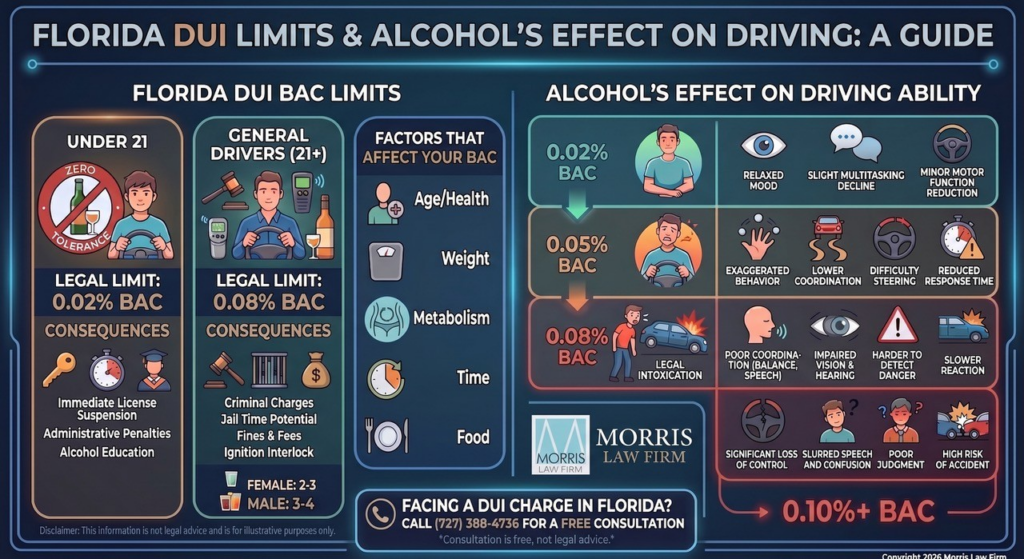
In Florida, the legal blood alcohol concentration (BAC) for adult drivers is 0.08%. For drivers under 21, the standard is much stricter. Under the state's Zero Tolerance Law, a BAC of just 0.02% can trigger serious penalties. This low threshold is equivalent to a single drink or even less, depending on body weight.

If a driver under 21 is found with a BAC of 0.02% or more, their license will be immediately suspended for six months, even on a first offense. This is an administrative penalty handled outside of the criminal court system. A second offense results in a one-year suspension.

Refusing to take a breath, urine, or blood test also carries consequences. A first refusal results in a 12-month suspension, while a second refusal leads to an 18-month suspension.

Difference Between Zero Tolerance and Standard DUI Charges

Zero tolerance violations are typically administrative and handled by the Florida Department of Highway Safety and Motor Vehicles (FLHSMV). However, minors can still face full criminal DUI charges if their BAC is 0.08% or higher or if law enforcement determines they are impaired to a degree that affects their driving ability. In some cases, a juvenile may even be charged as an adult.

Immediate and Long-Term Consequences of an Underage DUI

The consequences for underage drinking will follow your child well into adulthood. Whether it be for college admissions, sports, job hunting, etc., a DUI charge can follow them for the rest of their life if the right legal help is not acquired. 

License Suspension, Fines, and Other Penalties

An underage DUI charge in Florida can result in a number of fines and penalties including:

Repeat offenses or aggravating factors like causing an accident can lead to harsher sentencing. A skilled underage drinking lawyer will be able to minimize the potential penalties for your child.

Impact on School, Scholarships, and Future Opportunities

A DUI arrest or conviction can affect:

Even if a conviction doesn’t occur, the arrest itself can raise red flags for school and job applications. A DUI will follow an underage drinker into higher education unless they get the right legal team to help give them their life back.

Criminal Record, Insurance, and Employment Issues

A DUI conviction may:

These long-term effects can follow your child into adulthood if the situation isn't handled properly. Dreams can be ended in the blink of an eye, all because of a bad decision.

What to Do Right After a Juvenile DUI Arrest in Florida

After you get that phone call that your child has been arrested for an underage DUI or possession of alcohol charge, a million things might flash through your head. In these situations, it's important to stay calm and quickly contact an underage dui lawyer who can help your family.

Remember these important steps:

  1. Stay calm and encourage your child to be respectful during the arrest process.
  2. Advise your child not to make any statements or admissions to police.
  3. Contact an experienced St. Petersburg juvenile DUI attorney as soon as possible.
  4. Document everything your child remembers about the traffic stop and arrest.

Acting quickly helps protect your child’s rights and may reduce the chances of severe penalties.

How Morris Law Firm Protects Juveniles and Their Families

Experienced Juvenile and Underage DUI Defense

Morris Law Firm focuses on criminal defense in St. Petersburg and has extensive experience representing minors in underage DUI cases. We understand how the juvenile justice system works and are committed to protecting your child’s rights and future at every stage of the process.

Our goal is to minimize the legal, academic, and personal consequences of a DUI charge. Depending on the specifics of the case, we may pursue options such as:

We believe that one mistake shouldn't define a young person’s future. Our team will work to reduce the impact of the charge and help your child move forward with the second chance they deserve.

Contact Morris Law Firm for Help

Contact us at (727) 388-4736 to get the help you need. We’re committed to helping your family navigate this difficult time with clarity and confidence. No child deserves to have their life forever changed because of one bad decision.

Frequently Asked Questions for Parents About Underage DUI

Can my child be charged as an adult for a DUI in Florida?

Yes, especially if their BAC is 0.08% or higher or if the DUI involved an accident or injury.

Will a DUI stay on my child’s record forever?

A conviction can stay on a record permanently, but it may be eligible for expungement or sealing depending on the case.

What is the cost of a DUI in Florida?

In addition to fines and legal fees, you may face increased insurance premiums, lost educational opportunities, and long-term financial impacts.

Is a Zero Tolerance violation the same as a DUI charge?

No. A Zero Tolerance violation is usually an administrative offense for BAC levels between 0.02% and 0.079%. Criminal DUI charges apply at 0.08% or higher or if the driver is otherwise impaired.

What happens if my child refused a breath test?

Refusing a breath test can result in an automatic license suspension, but an attorney may be able to challenge the suspension and defend against criminal charges. Law enforcement can also request and be granted permission to perform a blood test.

Can Marijuana Smell Alone Can Lead To A DUI?

Can marijuana smell alone lead to a DUI?  In our opinion, yes it can, and here is why:

We have written extensively on the 2019 changes in the law that made Cannabidiol (CBD) legal in Florida and resulting confusion as to whether or not law enforcement could utilize the smell of marijuana alone as a legal basis to conduct a search or conduct a criminal investigation. See Marijuana Enforcement in Florida - A Haze of Confusion and Marijuana Smell Alone Is Back! Marijuana Enforcement In Florida - A Haze Of Confusion - Part 2

The Second District Court of Appeals (which is the controlling Appeals Court for the Tampa Bay region) has ruled that, “an officer smelling the odor of marijuana has probable cause to believe that the odor indicates the illegal use of marijuana” and thus law enforcement has probable cause for a warrantless search - including probable cause for a warrantless search of a vehicle.

While the “smell alone” ruling poses significant issues for citizens, there are even more consequences to the “smell alone” doctrine when it comes to Driving Under the Influence (DUI).

When a law enforcement officer makes a civil traffic stop they are always looking for any indications that the driver is impaired. The standard for an officer to switch the investigation from a civil traffic stop to a criminal investigation for DUI is “reasonable suspicion.” Reasonable suspicion is defined as the standard where a reasonable and objective person would suspect an individual of committing or intending to commit a crime. Once a law enforcement officer has reasonable suspicion that the driver may have his or her normal faculties impaired while operating a motor vehicle they can launch into a full criminal DUI investigation including Field Sobriety Tests.

Officers often will cite that the driver had bloodshot, watery eyes; an odor of alcohol on his or her breath; was slurring their speech, or was unsteady on their feet as a reasonable suspicion basis to conduct a criminal DUI investigation. With the “smell alone” doctrine alive and well in the Tampa Bay Area via the Second District Court of Appeals ruling, we can now add the odor of marijuana as yet another basis for law enforcement to conduct a criminal DUI investigation.

Additionally, the plain smell of marijuana further opens the door to allow law enforcement to conduct a warrantless search of the vehicle which may lead to additional criminal charges if the driver were for example to be in possession of marijuana or any other controlled substance or have any other illegal item in the vehicle.

Thus, the smell alone of marijuana, with other factors, could lead to a criminal DUI investigation when a person is pulled over and could be used as a basis to establish that the person was operating the vehicle with their normal faculties impaired.

If you have been arrested for Driving Under the Influence (DUI), Possession of Marijuana, or any other criminal offense in the Tampa Bay area including St. Petersburg, Tampa, Clearwater, or Largo call the Morris Law Firm for a strategy session on your case.  Call 727-388-4736, Option #1 for New Clients.