Voluntary vs. Involuntary Manslaughter Charges in Florida: Know Your Rights

Losing someone in a sudden, unexpected way is devastating enough. When that loss also comes with a criminal investigation, and possibly an arrest, the person facing charges is dealing with something almost incomprehensibly difficult: grief and the criminal justice system colliding at the same time. If you or a loved one is facing a manslaughter charge in Florida, understanding exactly what the law says, and what your rights are, matters enormously right now.

Morris Law Firm represents clients throughout St. Petersburg facing serious criminal charges, including manslaughter. Don’t leave your future up to chance. The consequences are real and will forever change the trajectory of your life. Call us today at (727) 388-4736 to discuss your situation.

Voluntary vs. Involuntary Manslaughter: The Core Difference

Voluntary manslaughter typically refers to a killing that occurs in the heat of passion, following adequate provocation, without the premeditation required for murder. 

Involuntary manslaughter typically refers to a killing that results from reckless or criminally negligent conduct, without any intent to kill at all. 

The core distinction usually comes down to intent and circumstance: voluntary manslaughter generally involves an intentional act committed in a moment of extreme emotional disturbance, while involuntary manslaughter generally involves an unintentional death caused by recklessness or negligence.

How Florida Actually Classifies Manslaughter

It is important to understand that Florida's manslaughter statute does not use the specific terms "voluntary" and "involuntary" the way some other states do. 

Instead, Florida Statute § 782.07 defines manslaughter broadly as the killing of a human being by the act, procurement, or culpable negligence of another, without lawful justification, and without falling under the state's murder statutes. 

Florida prosecutors and courts work within this broader statutory framework, meaning the voluntary and involuntary distinction is more of a general legal concept used to describe different types of manslaughter conduct, rather than two formally separate Florida charges.

Manslaughter, Aggravated Manslaughter, and Related Charges

Beyond standard manslaughter, Florida law includes related and enhanced charges depending on the specific circumstances of a case, including aggravated manslaughter of a child, elderly person, or disabled adult, which carries more severe penalties when the victim falls into one of these protected categories, and vehicular manslaughter, which applies specifically to a death caused by the operation of a motor vehicle in a reckless manner. 

Each of these charges carries its own specific statutory elements and potential penalties.

Manslaughter vs. Murder in Florida

The key distinction between manslaughter and murder in Florida generally comes down to intent and premeditation. 

Murder charges, particularly first-degree murder, generally require proof of premeditation, meaning the state must show the defendant planned or deliberated before the killing. 

Manslaughter, by contrast, does not require premeditation, and it can apply to situations ranging from a killing committed in the heat of the moment to a death caused entirely by reckless or negligent conduct, without any intent to kill at all.

What Prosecutors Must Prove

To secure a manslaughter conviction under Florida law, prosecutors generally must prove that the defendant's act, procurement, or culpable negligence caused the death of another person, and that the killing occurred without lawful justification, such as self-defense. 

Because manslaughter does not require the state to prove premeditation, the prosecution's focus is typically on establishing causation and the defendant's level of culpability, rather than proving a deliberate plan to kill.

Common Situations That Lead to Manslaughter Charges

Manslaughter charges in Florida can arise from a wide range of situations, including:

Every case depends heavily on its own specific facts, and the presence of intent, recklessness, or negligence significantly shapes how a case is ultimately charged and prosecuted. Two cases that look similar on the surface can result in very different charges depending on these underlying details, which is exactly why a thorough, individualized review of the evidence matters so much.

Penalties and Long-Term Consequences

Manslaughter is generally charged as a second-degree felony in Florida, carrying a maximum penalty of up to 15 years in prison and significant fines. 

Aggravated manslaughter of a child, elderly person, or disabled adult is charged more severely, as a first-degree felony, carrying a maximum penalty of up to 30 years in prison. 

Beyond incarceration, a manslaughter conviction carries a permanent felony record, which can affect employment, housing, and countless other areas of life well beyond the criminal case itself.

Defenses to Manslaughter Charges in Florida

Several defense strategies may apply depending on the specific facts of a case, including:

Because manslaughter cases often turn on nuanced questions of intent and causation, a thorough, independent investigation into the specific facts is essential to identifying which defense strategy may apply.

What to Do If You're Under Investigation or Charged

If you learn that you are under investigation, or if you have already been charged, exercising your right to remain silent and avoiding any statements to law enforcement without an attorney present is critical. 

Avoid discussing the details of the situation with anyone other than your attorney, including on social media, and write down everything you remember about the events in question as soon as possible, since memories can shift over time. 

Contacting an experienced criminal defense attorney with Morris Law Firm, P.A. immediately allows your rights to be protected from the earliest possible stage of the process.

How a St. Petersburg Criminal Defense Attorney Can Help

An experienced Florida manslaughter defense attorney can review the specific facts and evidence in your case, identify potential defenses, including self-defense or a lack of causation, and work to protect your rights at every stage, from the initial investigation through trial if necessary. 

Given the severity of these charges and the complexity of Florida's manslaughter statute, having an attorney who understands how these cases are actually charged and prosecuted matters enormously. 

In cases specifically involving a vehicle, Morris Law Firm, P.A’s DUI manslaughter defense team handles the additional legal considerations that come with those charges.

Talk to a Florida Manslaughter Defense Attorney

Whether you are facing a manslaughter charge or another serious offense, Morris Law Firm, P.A. has the experience and resources necessary to defend you. Melinda Morris, managing partner of the firm, is a former Assistant State Attorney with more than 15 years of experience fighting for the rights of the accused throughout the Greater Tampa Bay area. That background gives her genuine insight into how these cases are built and prosecuted, insight she uses to make sure every client understands their options and feels genuinely supported throughout the process.

Our broader St. Petersburg criminal defense team represents clients throughout Pinellas County and the surrounding areas, including Manatee, Sarasota, Hillsborough, Pasco, and Polk Counties, and is ready to review the specific facts of your situation and help you understand your rights.

If you or a loved one is facing a manslaughter investigation or charge in Florida, do not wait to get legal guidance. Contact Morris Law Firm at (727) 388-4736 for a free consultation.


Frequently Asked Questions

What's the Difference Between Voluntary and Involuntary Manslaughter?

In general legal terms, voluntary manslaughter typically involves an intentional killing committed in the heat of passion following adequate provocation, while involuntary manslaughter typically involves an unintentional death resulting from reckless or negligent conduct.

Does Florida Use Those Exact Terms?

No. Florida's manslaughter statute, under Florida Statute § 782.07, defines manslaughter broadly without formally separating it into voluntary and involuntary categories. The voluntary and involuntary distinction is a general legal concept, not a specific Florida statutory classification.

Is Manslaughter a Felony in Florida?

Yes. Standard manslaughter is generally charged as a second-degree felony in Florida, while aggravated manslaughter of a child, elderly person, or disabled adult is charged as a first-degree felony, carrying more severe potential penalties.

What's the Difference Between Manslaughter and Murder?

The key difference generally involves premeditation. Murder charges, particularly first-degree murder, require proof that the defendant planned or deliberated before the killing. Manslaughter does not require this element and can apply to killings that were unintentional or committed without any advance planning.

How a Simple Post on Social Media Could Lead to Criminal Charges in Florida

A single social media post, comment, or direct message can carry more legal weight than most people realize. What feels like venting after a bad breakup, joking with friends, or blowing off steam after an argument can, in the eyes of Florida law, become evidence of a crime. Threats, harassment, and even deleted posts can all resurface in a criminal investigation, sometimes long after the person who wrote them has moved on.

Morris Law Firm, P.A. has helped clients throughout St. Petersburg, Pinellas County, and the greater Tampa Bay area fight criminal accusations, including cases that started with something posted online. If you are worried that something you posted could lead to police contact, an arrest, or a probation violation, call us today at (727) 388-4736 to talk through your situation.

Online Posts Can Have Real Criminal Consequences

It is easy to think of social media as a casual, low stakes space, but Florida prosecutors increasingly treat online posts, messages, and videos as serious evidence. 

A comment made in anger, a screenshot shared in a group chat, or a livestream capturing something in the background can all become part of a criminal case, sometimes without the person ever realizing they crossed a legal line.

When Can Social Media Activity Become Evidence?

Social media activity becomes evidence any time it is relevant to a criminal investigation, whether law enforcement discovers it independently, a complaining witness provides it, or it surfaces through a search warrant served on a platform. Posts, comments, direct messages, videos, tags, and even livestreams can all be captured, screenshotted, and preserved as evidence, and content does not need to go viral or reach a large audience to become part of a criminal case.

What Types of Social Media Posts Can Lead to Charges?

A good rule of thumb is if you’re angry when you make a post, think twice, and especially avoid making any kind of post like the ones below.

Threats to Harm Someone

A post or message that threatens harm to another person, even one written impulsively during an argument, can lead to criminal charges under Florida law, regardless of whether the poster intended to actually follow through.

Cyberstalking or Repeated Harassment

Repeated unwanted contact or posts directed at a specific person, especially after being asked to stop, can rise to the level of cyberstalking under Florida law, even if no single post or message would be considered threatening on its own.

Doxing or Publishing Personal Information

Publishing someone's private information, such as their home address or personal contact details, with the intent to harass or intimidate them, can expose the poster to criminal liability under Florida's cyberintimidation statute.

Photos or Videos Showing Alleged Criminal Conduct

Photos or videos posted online can sometimes depict conduct that is itself illegal, or can serve as evidence connecting a person to an unrelated criminal investigation, even if the post itself was never intended to be incriminating.

Posts That Violate Probation, Bond, or a No-Contact Order

Individuals on probation, released on bond, or subject to a no-contact order can face additional charges or violations if their social media activity contacts a protected person, references prohibited conduct, or otherwise violates the specific terms of their release.

Messages Connected to Drugs, Weapons, Theft, or Violence

Direct messages or posts referencing drug sales, weapons, stolen property, or planned violence can all become central pieces of evidence in a broader criminal investigation, even when the original post was not shared publicly.

Florida Written or Electronic Threat Charges

Florida law criminalizes written or electronic threats under Florida Statute 836.10, which covers threats made in writing or through electronic communication, including social media posts, text messages, and direct messages. This statute applies broadly enough that a threatening comment posted publicly or sent privately can both potentially lead to charges, depending on the content and context of the message.

Cyberstalking and Online Harassment in Florida

Florida's stalking statute, Florida Statute 784.048, specifically addresses cyberstalking, defined generally as a course of conduct involving repeated electronic communications directed at a specific person that causes substantial emotional distress and serves no legitimate purpose. 

Separately, Florida Statute 836.115 addresses cyberintimidation by publication, covering situations where personal identifying information is published online with intent to incite violence or harassment against a person.

Can Police Use Deleted Posts or Screenshots Against You?

Deleting a post does not necessarily make it disappear from a legal standpoint. Screenshots taken by another person before deletion, cached versions of pages, and records obtained directly from a platform through a search warrant can all preserve content long after it has been removed from public view. 

In some cases, deleting a post after learning of an investigation can itself raise additional legal concerns, depending on the circumstances.

Possible Defenses in Social Media Criminal Cases

While the best defense is not making the post in the first place, an experienced criminal defense lawyer can use several strategies to try and distance a post from actual intent and harm.

Protected Speech or Lack of True Threat

Not everything that sounds alarming rises to the level of a true, prosecutable threat under Florida law. Courts distinguish between constitutionally protected speech, even if crude or offensive, and statements that meet the specific legal definition of a true threat.

Mistaken Identity or Fake Account Issues

Fake accounts, hacked profiles, and shared devices can all raise legitimate questions about whether a specific person actually authored a particular post or message, which can become a central issue in defending against these charges.

No Intent to Threaten, Harass, or Incite Harm

Many social media related charges require proof of a specific intent, such as intent to threaten, harass, or incite violence. Demonstrating that a post was made without this intent, even if poorly worded, can be an important part of a defense strategy.

Weak Screenshots, Missing Context, or Authentication Problems

Screenshots can be edited, taken out of context, or presented without the surrounding conversation that would clarify their meaning. Challenging the authenticity and completeness of digital evidence is often a critical part of defending these cases.

Illegal Search or Overbroad Digital Evidence Collection

If law enforcement obtained social media evidence without a proper warrant, or if a warrant was overly broad in scope, that evidence may potentially be challenged and excluded from the case.

How a Social Media Case Can Affect Your Future

A criminal charge stemming from a social media post can carry consequences well beyond the courtroom, including a permanent criminal record, complications with current or future employment, and, for those already on probation or subject to a no-contact order, additional violations that can affect ongoing cases. Given how much of daily communication now happens online, these cases are becoming more common, not less, making it important to take any related police contact seriously from the very beginning.

Talk to a St. Petersburg Criminal Defense Lawyer Today

Managing partner Melinda Morris founded Morris Law Firm, P.A. to help people throughout St. Petersburg and the surrounding Tampa Bay Area fight criminal accusations, and she and attorney Seth Shapiro bring that same commitment to cases involving social media related charges. Our St. Petersburg criminal defense attorney team handles cases involving cyberstalking defense, stalking and aggravated stalking, and injunctions for stalking throughout Pinellas County.

If you are facing charges related to a social media post, message, or video, do not wait to get legal guidance. Contact Morris Law Firm, P.A. today at (727) 388-4736 for a consultation, and let us help you understand your options and protect your future.

Are DUI Checkpoints Legal in Florida? What Happens and What to Expect

Getting caught off guard by a line of flashing lights and orange cones ahead can be an unsettling experience, even for drivers who have had nothing to drink. If you have ever wondered whether DUI checkpoints are actually legal in Florida, what police are allowed to do when they stop you, and what your rights are in that situation, this guide walks through everything you need to know.

At Morris Law Firm, our St. Petersburg DUI defense attorneys have extensive experience representing clients who were stopped at checkpoints throughout Florida. Whether you are trying to understand your rights before getting behind the wheel or you have already been charged following a checkpoint stop, we are here to help. 

Call us today at (727) 388-4736 for a free and confidential consultation.

Are DUI Checkpoints Legal in Florida?

Yes, DUI checkpoints are legal in Florida. The United States Supreme Court upheld the constitutionality of sobriety checkpoints in Michigan Department of State Police v. Sitz (1990), ruling that the public safety interest outweighs the brief intrusion on individual liberty. Florida follows this framework, and law enforcement agencies throughout the state regularly conduct DUI checkpoints, also called sobriety checkpoints or DUI roadblocks.

However, legality comes with conditions. Florida courts have established specific requirements that law enforcement must follow when operating a checkpoint. When those requirements are not met, a checkpoint may be challenged, and evidence gathered at it may be suppressed.

What Happens at DUI Checkpoints in Florida?

A DUI checkpoint is a temporary traffic stop operation where law enforcement officers stop vehicles at a fixed location to check for signs of impaired driving. Checkpoints are typically announced in advance, either through press releases or law enforcement social media, as this is one of the requirements Florida courts have established to make them legally permissible.

Checkpoints are set up on roads where drunk driving incidents are common or where high traffic volume makes enforcement practical. They are often conducted on weekend nights, holidays, and around major events.

What Do They Do If You Are Stopped at a DUI Checkpoint?

Unfortunately, there aren't a lot of options if you see a checkpoint ahead, whether you have been drinking of not. Here are some things that you should be ready to expect if you are stopped at a DUI checkpoint in Florida.

Officers Stop Vehicles Using a Set Pattern

Law enforcement cannot randomly decide which cars to pull over at a checkpoint. Florida law requires that stops follow a predetermined, neutral pattern, such as stopping every vehicle, every third vehicle, or every fifth vehicle. This requirement exists to prevent officers from using checkpoints as a pretext for targeting specific individuals. 

You'll Be Asked for License and Registration

The initial contact at a checkpoint is brief. An officer will ask you to provide your driver's license, vehicle registration, and proof of insurance. This is a standard, lawful request, and you are required to provide these documents.

Officers Look for Signs of Impairment

While you are stopped, the officer will be observing you for visible signs of impairment. These include the smell of alcohol or marijuana, bloodshot or watery eyes, slurred speech, slow or confused responses, and visible open containers in the vehicle. The initial stop is typically short, lasting only a minute or two for drivers who show no signs of impairment.

Some Drivers Are Sent to Secondary Screening

If an officer observes signs that suggest a driver may be impaired, that driver will be directed to a secondary screening area away from the main traffic flow. Secondary screening involves a more detailed interaction with an officer and may lead to field sobriety testing or a breath test request.

Possible Field Sobriety or Breath Testing

In secondary screening, officers may ask you to perform standardized field sobriety tests, which evaluate balance, coordination, and the ability to follow instructions. If those tests raise further concern, or if the officer believes there is probable cause to suspect impairment, a breath test may be requested. Refusing these tests has legal consequences discussed below.

What Are Your Rights at a DUI Checkpoint in Florida?

Understanding your rights at a checkpoint can make a significant difference in the outcome of an encounter with law enforcement. Key rights include:

What Happens If You Refuse a Breathalyzer?

Florida's implied consent law means that by driving on Florida roads, you have already consented to chemical testing if lawfully arrested for DUI. Refusing a breath, blood, or urine test after a lawful arrest results in an automatic license suspension of one year for a first refusal and 18 months for a second or subsequent refusal. 

A second or subsequent refusal is also a first-degree misdemeanor. Refusal can also be introduced as evidence against you at trial. This is a significant decision with real legal consequences, and anyone facing this choice should understand those stakes. Our attorneys discuss DUI tests and what they mean for your case in greater detail on our website.

Can You Avoid a DUI Checkpoint in Florida?

Legally, yes. If you see a checkpoint ahead and are able to make a legal turn to avoid it before reaching the stop point, you are generally permitted to do so. 

Simply avoiding a checkpoint is not, by itself, grounds for an officer to pull you over. However, if you make an illegal turn, fail to signal, or commit a traffic violation while attempting to avoid the checkpoint, that violation gives officers a legitimate reason to stop you independently of the checkpoint itself.

Can Police Search Your Car at a Checkpoint?

A routine checkpoint stop does not give officers the automatic right to search your vehicle. A search requires either your consent, a valid search warrant, or probable cause to believe that evidence of a crime is present. You have the right to decline a consent search. 

Declining a search request is not the same as admitting guilt, and an experienced DUI defense attorney can challenge any search that was conducted without a proper legal basis. 

Call us today at (727) 388-4736 to get a free consultation to make sure your rights are protected.

When DUI Checkpoints May Be Illegal

Not every checkpoint is legally conducted, and when law enforcement fails to follow the rules Florida courts have established, the checkpoint may be subject to legal challenge. 

A sobriety checkpoint may be challengeable when:

When a checkpoint does not meet these standards, a skilled defense attorney may be able to file a motion to suppress the evidence obtained as a result of the stop. If that evidence is suppressed, the prosecution's case often collapses.

When to Contact a Florida DUI Defense Attorney

A DUI charge in Florida carries serious consequences at every level. A first DUI can result in fines, license suspension, probation, and potential jail time. The penalties escalate significantly for a second DUI, a third DUI, and fourth or subsequent offenses, which can result in permanent license revocation and felony charges. If you were stopped at a checkpoint and charged with DUI, the circumstances of that stop, including whether the checkpoint was legally conducted, can be critical to your defense.

The best way to ensure your rights were observed is to contact a Florida DUI defense attorney with Morris Law as soon as possible after an arrest. Early involvement allows your attorney to preserve evidence, review the checkpoint's compliance with Florida law, and identify defenses before the case progresses.

Know Your Rights Before You Drive

A DUI checkpoint encounter does not have to result in a conviction. Florida law requires law enforcement to follow specific procedures, and when those procedures are not followed, defendants have legal recourse. 

Knowing your rights, staying calm, providing only what is required, and contacting an attorney quickly are the most important steps you can take.

Call Morris Law Firm Today

If you were stopped at a DUI checkpoint in Florida and charged with DUI, do not face it alone. The attorneys at Morris Law Firm are experienced in Florida DUI defense and understand how to evaluate checkpoint stops, challenge improper procedures, and pursue the best possible outcome for our clients. 

Contact us today at (727) 388-4736 to schedule your free, confidential consultation.

Can Dash Cam Footage Help Your DUI Defense?

Dash cameras are becoming more common in vehicles across the country. Many drivers install them to record traffic incidents, protect themselves in disputes, or simply document their time on the road. But if you are facing a DUI charge, you may wonder how dash cam footage could affect your case.

For drivers in St. Petersburg and throughout the state, video recordings can sometimes play an important role in criminal defense cases. In certain situations, dash cam footage may help clarify what happened before or during a DUI stop.

At the same time, recordings can also raise questions about how evidence is used in court. Understanding how dash cam footage may affect a DUI investigation can help you better prepare for your defense. At Morris Law Firm, our criminal defense attorneys know how to analyze dash cam footage and how to fully explain it in a court of law. 

Is Dash Cam Footage Admissible in Court?

Many people ask whether dash cam footage is admissible in court. In Florida, video recordings may be used as evidence if they meet certain legal standards.

Courts generally consider whether the footage is authentic, relevant to the case, and obtained legally. If the video clearly shows events related to the traffic stop, driving behavior, or interactions with law enforcement, it may be introduced during court proceedings.

Video footage may come from several sources, including:

Each type of recording may provide a different perspective on what occurred during the incident. By analyzing all footage relevant to the claim, we can assess the incident from every angle.

Can Dash Cam Footage Help a DUI Defense?

In some cases, dash cam video may support a DUI defense by providing additional context that may not appear in police reports. Video footage can sometimes show details that are difficult to capture through written descriptions alone.

For example, recordings may help illustrate:

Because DUI cases often rely heavily on observations made by law enforcement officers, video evidence may provide a clearer picture of what actually happened. That said, the impact of any video recording will depend on the facts of the case and how the footage is interpreted.

Can Dash Cam Footage Be Used Against You?

While dash cam recordings may help in some situations, they can also raise concerns for drivers facing DUI charges. Many people ask whether dash cam footage can be used against them in court.

The answer is yes, dash cam footage can be used against you. If a recording appears to show unsafe driving behavior or other evidence related to a DUI investigation, prosecutors may attempt to use the video during the case.

For example, footage might show erratic driving patterns, traffic violations, statements made during the traffic stop, essentially all the events leading up to your arrest. Because of this possibility, it is important to carefully review any video evidence before sharing or submitting it during an investigation.

Can You Send Dash Cam Footage to Police?

Some drivers wonder whether they should voluntarily send dash cam footage to police after an incident. In general, individuals are not required to provide personal recordings unless they are requested through legal procedures such as subpoenas.

Providing video evidence without first reviewing it carefully may create legal complications. Once footage is shared with law enforcement, it may become part of the evidence reviewed during the case.

If you believe dash cam footage may be relevant to your situation, it is often wise to discuss it with a defense attorney with experience handling DUI cases.

How Video Evidence Is Evaluated in DUI Cases

When reviewing video footage in a DUI case, courts look for details that either support or contradict the officer’s account of impairment. This may include how the driver spoke, moved, or followed instructions during the stop, as well as the conditions under which the footage was recorded. 

Judges and attorneys consider whether the video clearly shows signs of intoxication or if factors such as lighting, camera angle, or sound quality make the footage less reliable. Ultimately, the video is weighed alongside other evidence like test results and officer observations to determine its credibility and impact on the case.

Why Evidence Review Matters in DUI Defense

DUI cases frequently involve technical and procedural details. The accuracy of testing equipment, the legality of the traffic stop, and the way evidence was collected may all play a role in the outcome.

Video recordings sometimes help confirm what happened during the encounter, but they may also raise new questions that require careful examination. Reviewing all available evidence early in the case may help identify issues related to the stop, testing procedures, or the conduct of the investigation.

Speak With a St. Petersburg DUI Defense Attorney

If you are facing a DUI charge and have questions about dash cam footage or other evidence in your case, it may help to speak with a criminal defense attorney who understands Florida DUI procedures.

The attorneys at Morris Law Firm represent individuals facing DUI and other criminal charges in St. Petersburg and the surrounding areas.

To discuss your situation and learn more about your legal options, contact Morris Law Firm today at (727) 388-4736 to schedule a consultation. Understanding how evidence may affect your case can help you prepare for the legal process ahead. 

What Happens at Your First DUI Court Appearance in Florida?

Being arrested for DUI can leave you with many questions. One of the biggest concerns people have is regarding their upcoming court date. If you have never been through the criminal justice system before, it is normal to feel uncertain about what will happen when you appear before a judge.

For drivers in St. Petersburg and throughout the state of Florida, the first court appearance after a DUI arrest often focuses on procedural steps rather than the final outcome of the case. Still, knowing what to expect at your DUI court hearing can help reduce stress and help you prepare.

At Morris Law Firm, we can help you understand what typically happens on your first DUI court date in Florida. Reach out to our attorneys at (727) 388-4736 to discuss your next steps.

Why the First DUI Court Appearance Matters

Your first court appearance after a DUI arrest is commonly referred to as an arraignment. During this hearing, the judge formally informs you of the charges against you and asks how you intend to plead. This hearing usually takes place several weeks after the arrest, depending on the court schedule. The goal of the arraignment is to begin the formal legal process.

At this stage, the court is not deciding whether you are guilty or innocent. Instead, the focus is on confirming the charges, addressing your legal representation, and setting the next steps for your case.

What to Expect at Your DUI Court Hearing

While every case is different, most first DUI court appearances follow a similar process.

During the hearing, the court may:

Many defendants enter a not guilty plea at this stage so their attorney can review evidence and explore possible defenses. After the arraignment, the case usually moves into the pretrial phase.

The hearing itself is often brief and may last only a few minutes.

What the Judge May Ask During Your First DUI Court Date

The judge may ask a few basic questions to confirm important information. These questions typically focus on procedural matters rather than the details of the incident.

For example, the judge may ask whether:

If you do not yet have an attorney, the court may give you time to retain one before the next hearing. Because statements made in court can affect your case, it is generally wise to keep answers brief and avoid discussing details about the arrest.

Possible Outcomes of the First DUI Hearing

Your first court appearance usually does not determine the final outcome of your case. Instead, it sets the stage for the next phase of the legal process.

After the arraignment, the case may move forward with:

Some DUI cases resolve through negotiated agreements, while others proceed further through the court system. At Morris Law Firm, our DUI attorneys create legal strategies that will focus on the evidence involved and the circumstances surrounding the arrest.

Preparing for Your First DUI Court Appearance

If you are wondering what to expect on your first DUI court date, preparation can make the process smoother.

Here are a few practical steps to consider before the hearing:

Showing respect for the court and arriving prepared can help the hearing proceed without unnecessary complications.

The Importance of Legal Guidance in DUI Cases

DUI charges can carry serious consequences in Florida. Penalties may include license suspension, fines, probation, mandatory education programs, and in some cases, jail time.

Beyond the immediate penalties, a DUI conviction can also affect employment, insurance rates, and your driving record. Because of these potential consequences, it is important to fully understand the legal process and your available options.

An experienced criminal defense attorney can review the circumstances of the arrest, examine the evidence, and determine whether issues such as improper traffic stops, inaccurate testing procedures, or other legal concerns may affect the case.

Speak With a St. Petersburg DUI Defense Attorney

If you have a DUI court date coming up and are unsure what to expect, it may help to speak with a DUI defense attorney who understands how Florida DUI cases move through the courts.

The attorneys at Morris Law Firm, represent individuals facing DUI and other criminal charges throughout the St. Petersburg area.

To discuss your situation and learn more about your legal options, contact the office today at (727) 388-4736 to schedule a consultation.

DUI vs. BUI in Florida: What Drivers and Boaters Need to Know

Florida’s roads and waterways are both heavily traveled, especially in St. Petersburg and throughout the Tampa Bay area. With that activity comes strict enforcement of impaired driving and boating laws. Many people are surprised to learn that Florida treats driving under the influence and boating under the influence as separate offenses with different rules, procedures, and consequences.

At Morris Law Firm, our criminal defense lawyers defend drivers and boaters charged with DUI and BUI throughout St. Petersburg and the surrounding communities. Understanding DUI vs. BUI in Florida is important whether you are behind the wheel of a car or operating a vessel on the water. While the two offenses share similarities, they are governed by different statutes and enforced in very different ways. 

What Is a DUI in Florida?

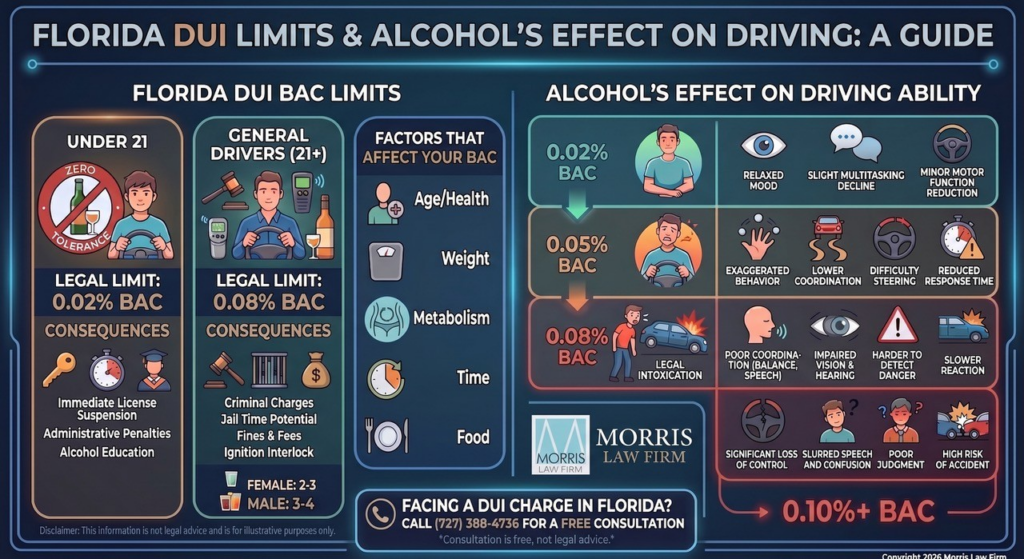
A DUI in Florida occurs when a person drives or is in actual physical control of a motor vehicle while impaired by alcohol, drugs, or a combination of substances. Under Florida law, impairment can be established in two main ways.

First, a driver may be charged if their blood alcohol concentration is 0.08% or higher. Second, even with a lower BAC, a person can still face DUI charges if law enforcement believes their normal faculties were impaired.

DUI charges often arise from traffic stops for speeding, weaving, accidents, or other alleged violations. Florida law allows DUI charges to be based on alcohol, illegal drugs, prescription medications, or any substance that affects a person’s ability to drive safely.

What Is a BUI in Florida?

Boating under the influence applies when a person operates a vessel while impaired by alcohol or drugs. Florida defines a vessel broadly. It includes motorboats, jet skis, sailboats, and many other watercraft used on the state’s waterways.

Like DUI, a BUI can be charged if the operator has a BAC of 0.08% or higher, or if their normal faculties are impaired. The key difference is the setting. BUI laws apply on rivers, lakes, bays, and coastal waters rather than public roadways.

Because Florida has extensive coastlines and boating activity, BUI enforcement is common in areas like Tampa Bay, especially during weekends and holidays.

Stops, Investigations, and Testing for DUI & BUI in Florida

One of the biggest differences between DUI vs. BUI in Florida is how stops and investigations occur.

How DUI Traffic Stops Work on the Road

DUI investigations typically begin with a traffic stop. Police must have reasonable suspicion that a traffic violation or criminal activity occurred. This may include speeding, running a red light, or erratic driving.

Once stopped, officers look for signs of impairment such as slurred speech, bloodshot eyes, or the smell of alcohol. Drivers may be asked to perform roadside field sobriety tests and submit to breath testing. Florida law requires officers to follow strict procedures during DUI stops. Violations of these rules can lead to suppressed evidence or dismissed charges.

How BUI Stops Work on the Water

BUI stops are very different. Law enforcement officers and marine patrol units can stop vessels without the same level of suspicion required for traffic stops. Officers are allowed to conduct safety inspections, check registrations, and ensure compliance with boating regulations.

During these encounters, officers may begin a BUI investigation if they observe signs of impairment. Field sobriety exercises on the water are often less standardized and may take place on a dock or onboard the vessel. This broader authority to stop vessels makes BUI cases unique and often more challenging to defend.

Refusing DUI vs. BUI Testing and the Consequences

Florida’s implied consent law applies differently to DUI and BUI cases. Drivers who refuse breath, blood, or urine testing after a lawful DUI arrest face an automatic driver’s license suspension. A first refusal typically results in a one year suspension, with longer suspensions for subsequent refusals.

In BUI cases, refusing testing does not result in a driver’s license suspension. However, refusal can still be used as evidence against the operator in court and may influence how the case is prosecuted. Understanding these differences is critical before making decisions during an investigation.

Penalties: DUI vs. BUI Side by Side

Although DUI and BUI share similarities, the penalties are not identical.

Criminal Penalties for a First DUI in Florida

The penalties for a first time DUI conviction in Florida can result in jail time of up to six months, fines, probation, community service, and mandatory DUI school. If the BAC is 0.15% or higher or a minor was in the vehicle, penalties increase.

Administrative penalties include a driver’s license suspension, possible ignition interlock requirements, and increased insurance costs.

Criminal Penalties for a First BUI in Florida

A first BUI conviction carries penalties similar to DUI in terms of fines, probation, and potential jail time. However, there is no automatic driver’s license suspension for a BUI conviction.

Courts may still impose conditions such as substance abuse evaluations, boating safety courses, and restrictions on operating vessels.

Enhanced Penalties for Accidents, High BAC, and Priors

Both DUI and BUI penalties increase significantly if aggravating factors are present. These include high BAC levels, prior convictions, accidents causing property damage, serious bodily injury, or death.

Felony charges may apply in serious cases, leading to prison exposure and long term consequences that extend far beyond the courtroom.

Defending DUI and BUI Charges in St. Petersburg

Strong defense strategies depend on understanding the unique aspects of each type of case.

Common Defenses in DUI Cases

DUI defenses often focus on the legality of the traffic stop, the accuracy of breath or blood testing, and whether field sobriety exercises were administered properly. Medical conditions, improper calibration of testing devices, and violations of constitutional rights can all weaken the prosecution’s case.

Challenging the officer’s observations and procedures is often key to achieving reduced charges or dismissal.

Common Defenses in BUI Cases

BUI defenses frequently involve questioning the legality of the vessel stop, the reliability of impairment observations on the water, and the conditions under which testing occurred.

Environmental factors such as weather, waves, and vessel movement can affect balance and coordination, making field sobriety observations less reliable. These factors must be carefully examined when building a defense.

Why Choosing an Experienced St. Petersburg DUI and BUI Lawyer Matters

DUI and BUI in Florida are serious offenses, but they are not the same. Each involves separate laws, enforcement practices, and potential penalties. Attempting to navigate either charge without experienced legal guidance can put your freedom, finances, and future at risk.

At Morris Law Firm, we represent clients charged with DUI and BUI throughout St. Petersburg and the Tampa Bay area. We provide comprehensive legal defense based on a deep understanding of local law enforcement practices and prosecutorial strategies.

We approach every case carefully, reviewing every detail to protect your rights and pursue the best possible outcome:

If you or a loved one is facing DUI or BUI charges, do not wait to get help. Contact us today at (727) 388-4736 to discuss your case and learn how we can defend you against serious criminal charges throughout St. Petersburg and the Tampa Bay area.